
Safety
Questionnaire.
Before a magnetic resonance scan, a CT with contrast, a mammography or a bone densitometry, there is a safety questionnaire to complete. It confirms that the exam is suitable for you, flags any situations that call for care and helps you prepare well for your visit. You can complete it online, download the PDF form or fill it in with us, at the clinic.
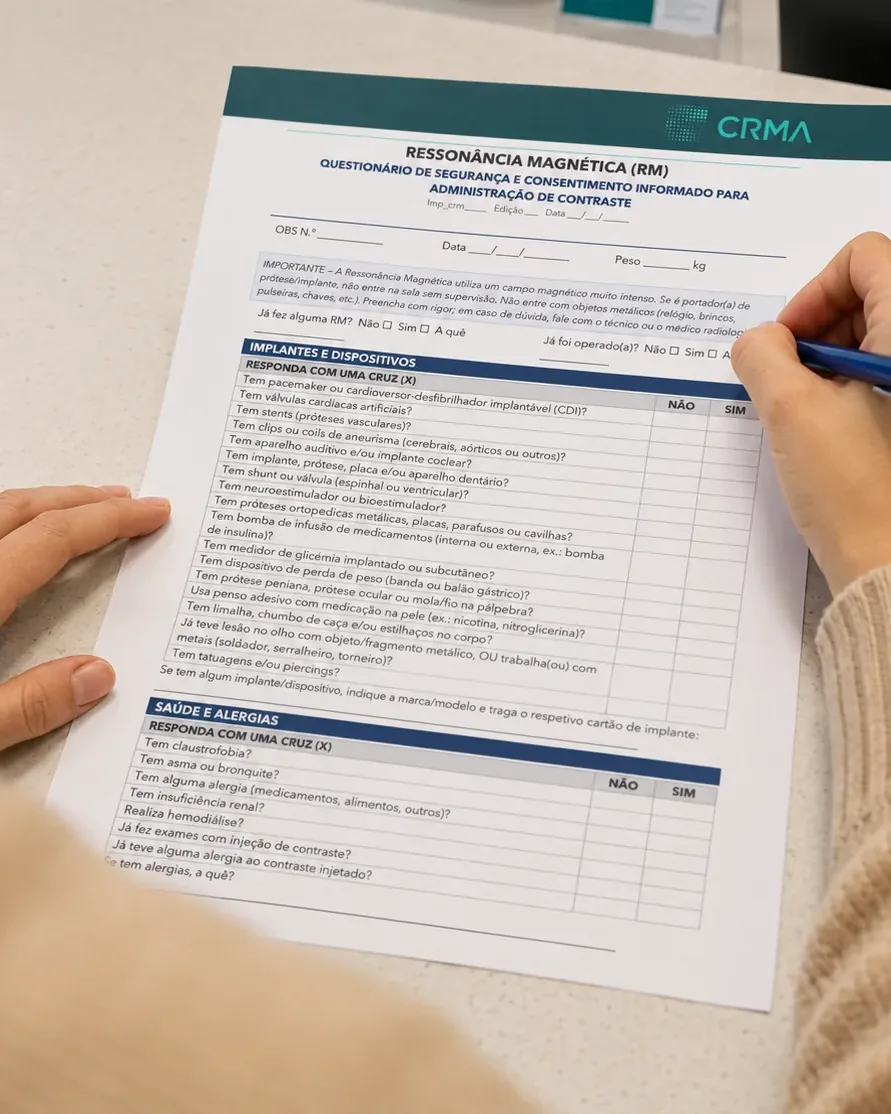
The safety questionnaire exists for your protection. It is not a way of refusing exams — it is how we carry them out safely. It applies to MRI, to CT with contrast, to mammography and to bone densitometry. You can complete it online, on paper or with our team — review and signing always take place at the clinic.
Preparing your exam ahead of time, and safely.
Some exams require certain conditions to be confirmed beforehand. Doing this before the day avoids surprises on arrival, allows the most suitable protocol to be chosen and reduces the need to repeat or postpone the exam.
Safety
Confirms that the exam can be carried out safely — especially for MRI, whose magnetic field calls for care with implants and metal objects.
The right protocol
Helps the radiologist define the best protocol for your case, including the decision on contrast, where applicable.
Less waiting
Clearing up any questions before the day avoids cancellations on arrival and reduces waiting time at the clinic.
What we confirm, depending on the exam.
The questions vary according to the exam you are having. These are the aspects the team confirms in each case.
The information below is general in nature and has been validated by CRMA's Clinical Board. The safety assessment of each exam is always individual and carried out by the clinical team; if in doubt, talk to us.
Magnetic Resonance Imaging
MRI forms its images by combining a very intense magnetic field — which is always on, even outside the exam — with radiofrequency waves and magnetic fields that vary very quickly during acquisition. Because of these electromagnetic phenomena, we confirm the presence of devices and implants that call for care — pacemaker, defibrillator, neurostimulator, cochlear implant, aneurysm clips, some prostheses — and the possibility of metal foreign bodies (for example, a history of welding or shrapnel). We also cover claustrophobia, tattoos and piercings, and pregnancy. Some MRI exams may involve an injection of contrast (gadolinium) — in that case we also confirm allergies, kidney function and breastfeeding, and you are asked for written consent.
CT with contrast
This uses intravenous iodinated contrast, with your written consent. We confirm allergies — in particular previous reactions to contrast —, asthma, kidney function, diabetes and medication (metformin), thyroid disease (in particular hyperthyroidism or goitre), and also pregnancy or breastfeeding. If you take metformin or have kidney disease, it may be necessary to assess kidney function and, in certain cases, to stop metformin for 48 hours after the contrast — the team will tell you how to proceed.
Mammography
We confirm pregnancy and breastfeeding, any breast implants and previous breast surgery, current symptoms, relevant personal and family history and hormonal medication (hormone replacement therapy, contraceptives). Always bring your previous exams — images and reports are essential for comparison.
Bone densitometry
Densitometry is not performed during pregnancy — we always confirm that possibility. We also confirm recent exams with contrast or nuclear medicine, metal prostheses in the area to be studied, relevant risk factors and bone medication. Do not take calcium supplements on the day of the exam and, if you have had densitometry before, bring the previous report.
What to have to hand.
To answer with ease, have these items with you when you speak to the team or come to the clinic.
Your medical referral
You may need to state the exam and the area to be studied, as they appear on the referral.
Your list of medication
Have to hand the medication you take regularly — some of it is relevant to the safety of the exam.
Your device card
If you have a pacemaker, prosthesis, stent, valve or other implant, bring the device card or the documentation from when it was fitted.
Your previous exams
For mammography and densitometry, previous images and reports are essential for comparison — always bring them, especially if the exams were done at another clinic.
You can have help
If you prefer, answer with the help of a family member or carer. And if you are not sure of an answer, tell us — we will go through it with you.
Would you rather answer the questions at home?
After requesting your booking, you can complete the questionnaire in two ways — online or on paper. Either way, review and signing always take place at the clinic, with our team — and if you have doubts about any question, leave it blank: we will go through it with you.
Fill it in online
Answer calmly, at home, and we receive your answers already in the format of the official form. On the day of the exam, the questionnaire is ready — you just need to review it with our team and sign it.
Fill it in online →Download and print
Download below the official form for your exam as a PDF, print it, fill it in at home and bring it with you on the day of the exam.
Magnetic Resonance Imaging
Safety questionnaire and informed consent for the administration of contrast.
Download PDF →CT with contrast
Questionnaire and informed consent for the administration of iodinated contrast.
Download PDF →Official CRMA forms in force. The forms are available in Portuguese, English and French, and our team assists in PT, EN and FR. Each file is about 300 KB (PDF).
What happens next.
Whenever possible, we carry out an initial triage by phone, when we confirm your booking. If you complete it online, we receive your answers already in the format of the official form; if you bring the completed PDF, we take it from there. Either way, the questionnaire is reviewed and signed at the clinic, before the exam, with the support of our team.
Triage at confirmation
When we confirm your booking, our assistants aim to go through the essential questions with you; more complex doubts are cleared up with a radiographer or radiologist. If in doubt, the decision on whether to carry out the exam always rests with the radiologist.
Confirmation or adjustment
If everything is clear, the booking stands. If something needs to be clarified or the protocol adjusted, we will contact you by phone or email.
On the day of the exam
You go through your answers verbally with our team and sign the questionnaire. For MRI, before entering the room, you remove all metal objects and put on the gown provided; external devices (such as an insulin pump or glucose sensor) are managed with the radiographer.
Consent for contrast
For exams that may involve contrast (MRI and CT), you are asked for written authorisation before it is administered. You may authorise or not authorise — and you may withdraw your decision at any time, even after signing.
If anything changes
If, between booking and the exam, anything changes (new medication, suspected pregnancy, new surgery), let us know straight away by phone.
Book your exam or talk to us.
If you don't have a booking yet, start here. If you have questions about the questionnaire, our team can help you by phone.