
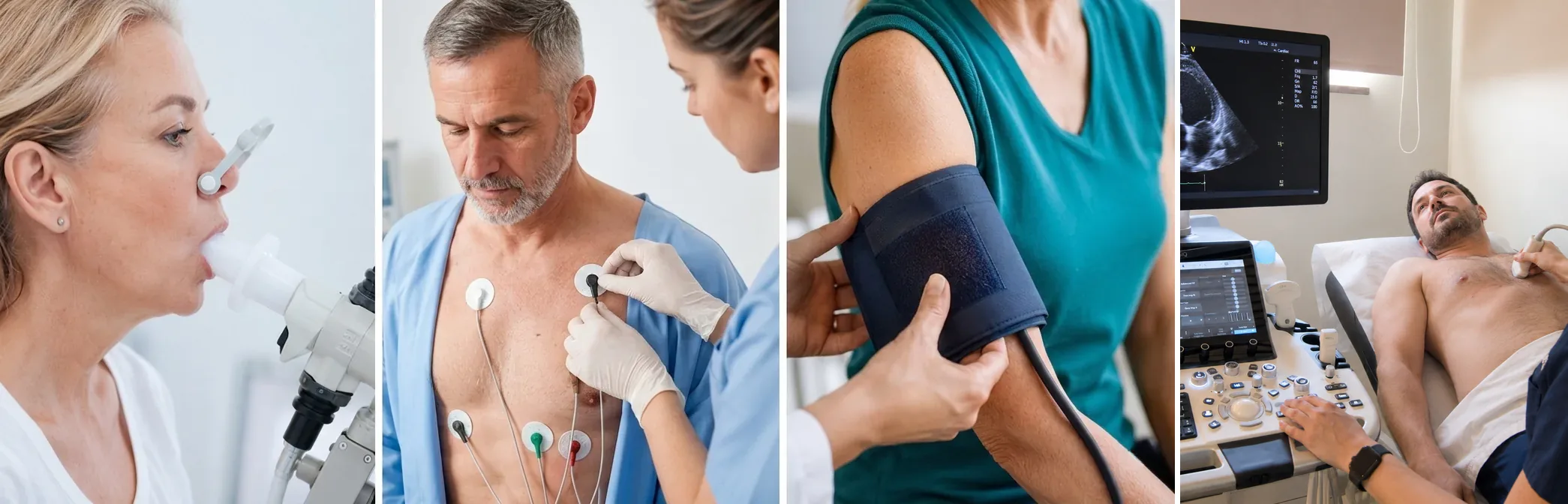
Which exams are performed?
- Echocardiogram with Doppler — an ultrasound scan of the heart: allows assessment of the chambers, the valves and cardiac function. Also available with tissue Doppler and combined with an ECG.
- Electrocardiogram (ECG) — a recording of the heart's electrical activity, at rest, with electrodes on the skin.
- Holter — a portable recorder that captures the heart rhythm over 24 hours, during your normal daily life.
- ABPM — 24-hour ambulatory blood pressure monitoring, with an automatic cuff.
- Spirometry — assessment of lung function; available with a bronchodilator (reversibility) test.
When it is requested
- Murmurs, palpitations, tiredness or shortness of breath — cardiac assessment on your doctor's advice.
- High blood pressure — ABPM assesses how your blood pressure behaves through the day and night.
- Suspected arrhythmias — the Holter records episodes that a one-off ECG may not capture.
- Asthma, COPD or a chronic cough — assessment of lung function by spirometry.
- Pre-operative assessment, when requested by your treating doctor.
What the exam is like
- 1Before
Reception
Arrive with your referral. Any preparation is noted when you book.
- 2
The exam
The ECG and echocardiogram are done there and then, lying on a couch. For spirometry, you breathe out through a mouthpiece following the professional's instructions.
- 3Holter/ABPM: 24 h
24-hour exams
For the Holter and ABPM, the device is fitted at the clinic and taken home; you return the next day to have it removed, keeping your usual routine throughout the recording.
- 4
Finishing up
No restrictions after the exams; for the Holter and ABPM, the report is written once the recording has been read.
Preparation
- ECG and echocardiogram: no preparation; avoid body creams on the chest on the day of the exam.
- Holter and ABPM: shower before it is fitted — the device must not get wet during the 24 hours; wear comfortable clothing.
- Spirometry: do not come fasting; do not drink coffee in the hour before the exam. If you are taking an antibiotic, finish the course and have the spirometry only one week after completing it.
- Regular medication: continue as usual, unless your referring doctor advises otherwise.
Results
The exams are performed by qualified professionals, with the collaboration of cardiologists and pulmonologists; the spirometry report is written by a pulmonologist. The report is available as a PDF (by email or printed) and, with your written authorisation, can be sent directly to your referring doctor.