
Prevention and Imaging Check-up.
Preventive imaging assessment programmes, designed case by case by CRMA's medical team — with defined clinical criteria and transparency about what each exam allows, and does not allow, to be assessed.
CRMA's Prevention and Imaging Check-up programme, in Faro, offers preventive assessment modules — heart and vessels, brain, brain ageing, lung, prostate, breast, abdomen and whole-body MRI — defined case by case by CRMA's medical team, after a prior assessment of each person's profile. We don't sell fixed packages: the combination of exams is personalised, with criteria based on international recommendations. The first step is to get in touch — +351 289 892 100.
Assessment first. Exams afterwards.
Get in touch
Call us or leave your request in the form on this page. We don't ask for health data online — only your contact details and the module you're interested in.
Prior assessment by CRMA's medical team
By phone, in person or based on your clinical documents. The medical team assesses your profile — age, history, risk factors, previous exams — and confirms whether the exams are justified in your case.
Personalised plan, exams and report
You receive a plan with the exams suited to your profile and the corresponding quote. Reports are produced by a radiologist, with clear guidance on the next steps — and coordination with your own doctor when appropriate.
Nine modules, a plan tailored to each person.
Each module indicates, for information, the profiles for which it is usually considered — based on international recommendations. The final decision always rests with the prior assessment. No module is "for everyone".

Heart and Vessels
Coronary calcium score (CACS) and coronary CT angiography, reviewed together with cardiology. They allow assessment of the calcification and plaque in the coronary arteries — information used in cardiovascular risk stratification.
Adults with intermediate cardiovascular risk or risk factors (family history, smoking, high blood pressure, cholesterol, diabetes), typically from the age of 40.
 MRI · no radiation
Brain and Neck Vessels
Cerebral MR angiography (TOF technique — quick, radiation-free and usually without contrast) and Doppler ultrasound of the carotid and vertebral arteries. It allows assessment of the cerebral arteries, including screening for aneurysms, and the arteries of the neck.
Family history of cerebral aneurysm or stroke, and profiles with vascular risk factors — case by case, at the prior assessment.
 MRI · no radiation
Brain Ageing
Head MRI with a dedicated protocol — T2, FLAIR, 3D T1, SWI and diffusion; MR angiography when indicated. It allows assessment of signs of small-vessel disease, microbleeds, white-matter changes and patterns of atrophy.
Adults with vascular risk factors, mild cognitive concerns to clarify with their doctor, or a relevant family history.

Lung
Chest CT with a low-dose protocol and structured reporting (Lung-RADS). It allows assessment of the lung parenchyma, including the identification of nodules.
Current and former smokers with a significant smoking history, typically between the ages of 50 and 80 (international recommendations).
 Coming soon
Colon
CT colonography (virtual colonoscopy) — a non-invasive assessment of the colon, without sedation, recognised as a colorectal screening option by international recommendations. Positive findings may require a subsequent colonoscopy.
Adults from the age of 45–50. Available soon — register your interest and we'll let you know.
 MRI · no radiation
Prostate
Multiparametric prostate MRI, with PI-RADS classification, alongside the PSA value and risk profile.
Men with a raised PSA or under surveillance, family history or other risk factors — in dialogue with their doctor/urologist.

Breast
Mammography with 3D tomosynthesis as the baseline assessment; breast MRI reserved for increased-risk profiles (ACR/ESR recommendations).
Women within the recommended screening ages; breast MRI for high familial/genetic risk, defined at the prior assessment.
 Ultrasound · no radiation
Abdomen
Complete abdominal ultrasound, including screening for abdominal aortic aneurysm (AAA) — with no radiation at all. It assesses the liver, gallbladder, kidneys, spleen and abdominal aorta.
General assessment; AAA screening is recommended above all for men aged 65 to 75 with a history of smoking.
 MRI · no radiation
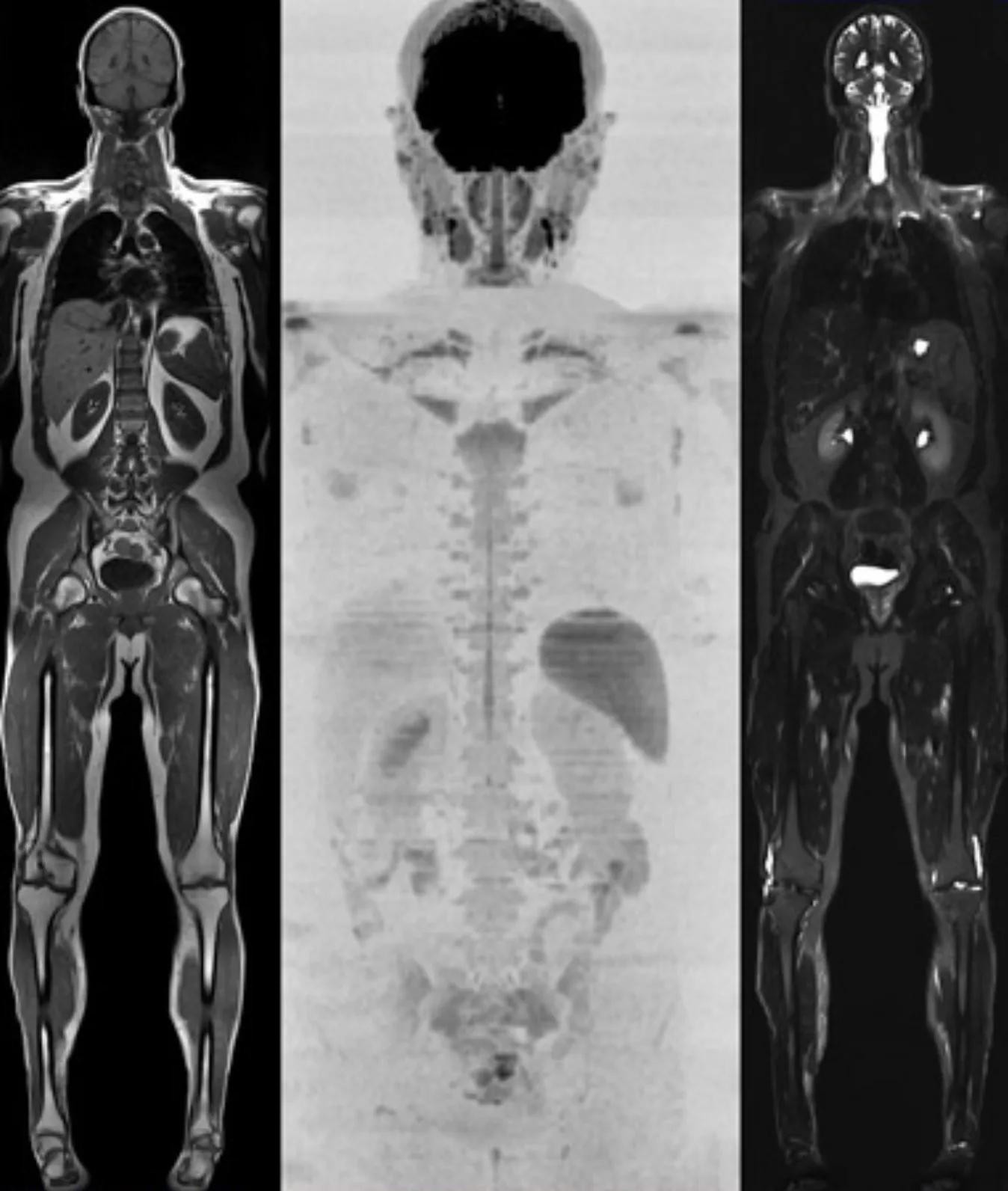
Whole-Body MRI
From the vertex to the mid-thigh, without contrast as a rule, with a protocol following international recommendations (MY-RADS/ONCO-RADS): T1 Dixon, STIR/T2 and diffusion. Reports with structured classification and comparison with previous exams. It does not replace mammography, colonoscopy, cytology, low-dose lung CT or PSA.
Oncological context with an indication; annual surveillance of hereditary predisposition syndromes (e.g. Li-Fraumeni, VHL, neurofibromatoses); broader preventive assessment within a responsible framework.
Prevention with judgement, not exams "for everyone".
- Preventive imaging assessment complements — it does not replace — follow-up with your own doctor and organised screening programmes (mammography, colonoscopy, cytology, PSA).
- A normal result does not rule out disease, and no exam guarantees diagnoses. Each module has its scope and limitations, explained before it is carried out.
- Imaging exams may reveal incidental findings — changes of no significance that may nonetheless require additional exams. That is also why the prior assessment is mandatory.
- For exams involving ionising radiation (CT), carrying them out in people without symptoms requires documented individual medical justification — taken on by CRMA's medical team, under radiation-protection legislation.
- Before any exam in this programme, you sign a specific informed consent form.
About prevention and imaging check-up.
Do I need a medical referral to have an imaging check-up?
You don't need to bring a referral: for preventive exams, it is CRMA's medical team that assesses your profile and takes on the indication for the appropriate exams, at the prior assessment. If you prefer, you can involve your own doctor — we're glad to coordinate with them.
Can I just book a package of exams?
No — and that's deliberate. We don't sell fixed packages: each plan is defined at the prior assessment, because too many exams can carry risks (unnecessary radiation, findings of no significance that cause anxiety and more exams) with no benefit to you.
How much does it cost?
The cost depends on the exams that end up being defined in your plan. You receive the full quote following the prior assessment, before any booking.
Do the exams involve radiation?
It depends on the module. MRI (brain, brain ageing, prostate, breast, whole body) and ultrasound use no radiation. CT (heart, lung, colon) uses X-rays in optimised protocols — for the lung, with a low-dose protocol. The justification for each exam involving radiation is assessed individually.
Does whole-body MRI replace the other screening programmes?
No. Whole-body MRI does not replace mammography, colonoscopy, cytology, low-dose lung CT in smokers or PSA. It is a broad exam with its own indications, defined at the prior assessment.
What if something shows up?
The report clearly distinguishes clinically relevant findings from those of no significance. When something warrants follow-up, CRMA's medical team indicates the next steps and, with your permission, coordinates with your own doctor or the appropriate specialty.
I'm a foreign visitor passing through the Algarve. Can I have the check-up?
Yes. We provide service in Portuguese, English and French, and we work with partner healthcare units that look after foreign residents and visitors. The process is the same: get in touch, prior assessment and a personalised plan.
How soon do I get the results?
Reports are produced by a radiologist and the turnaround is given at the time of booking, depending on the set of exams carried out.
Start with the assessment. We'll take care of the rest.
Leave us your contact details and the module you're interested in — CRMA's medical team reviews the request and our team calls you during working hours. If you prefer, call us directly: +351 289 892 100.
We've received your request.
CRMA's medical team will review it and our team will contact you during working hours for the prior assessment. This is not yet a booking.
Talk to CRMA.
In Faro, with personal service in PT, EN and FR. The right plan starts with the right assessment.