Mon–Fri 08:00–19:00 · Sat 08:00–13:00· Faro· +351 289 892 100· geral@crmalgarve.pt PTENFR
CRMA
Medical imaging · X-ray imaging

Mammography (with 3D Tomosynthesis)

A breast imaging exam, performed with a low dose of X-rays. Available at CRMA with three-dimensional tomosynthesis — a technique that produces images of the breast in thin slices.

Duration10–20 min
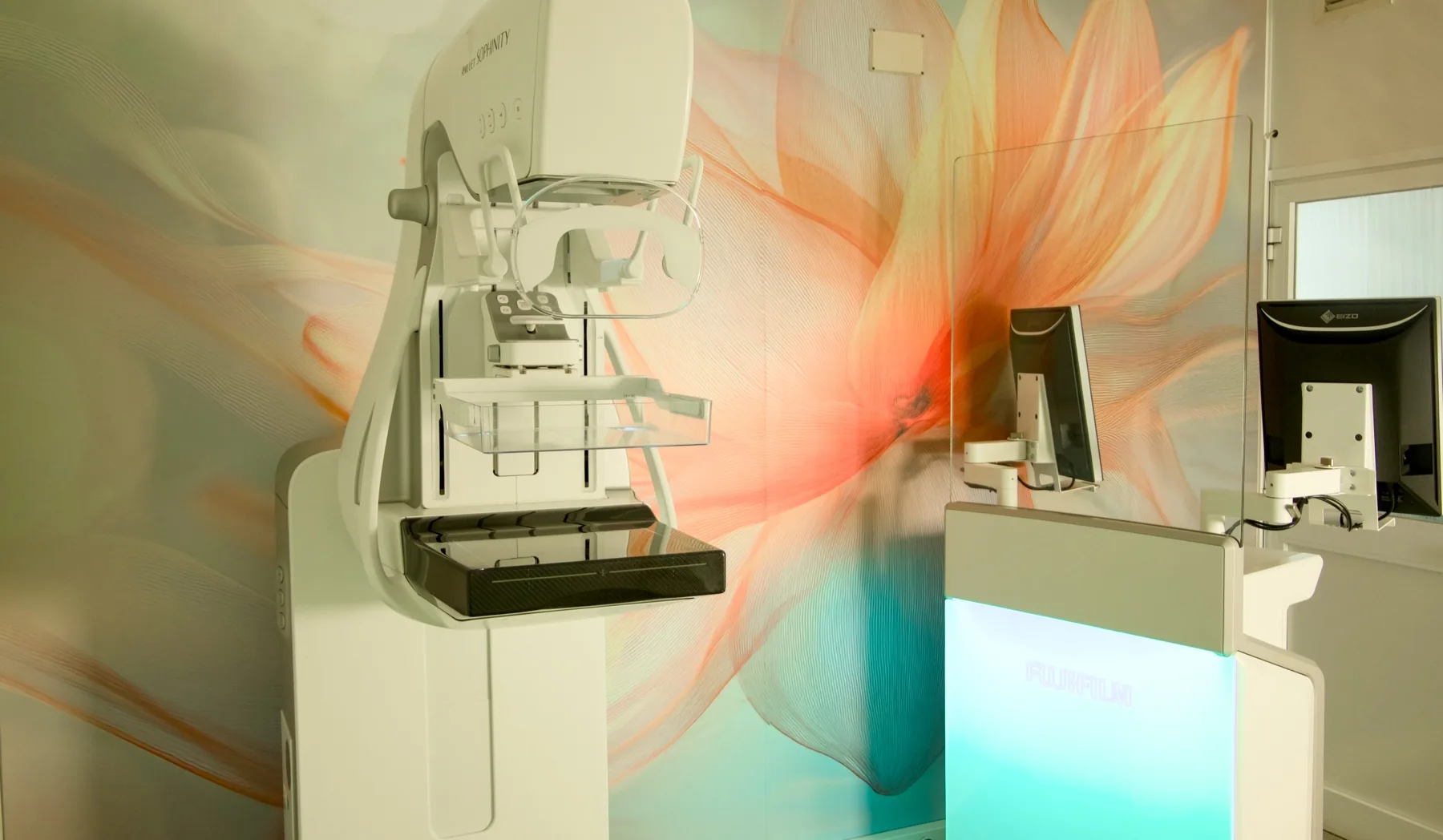
EquipmentFujifilm Amulet Sophinity
ContrastNo
PreparationNo fasting
CRMA's Mammography room, in Faro
In summary

Mammography uses low-dose X-rays to study the breast tissue, for screening and to assess breast changes. At CRMA, in Faro, it is performed on a Fujifilm Amulet Sophinity direct digital mammography unit, with 3D tomosynthesis. The exam usually takes 10 to 20 minutes and the ideal time is between the 7th and 12th day after your period starts.

What mammography is

Mammography is an imaging exam that uses low-dose X-rays to produce detailed images of the breasts. It is often requested for screening or to assess breast changes identified by the doctor or by the person themselves.

CRMA performs mammography in two modes: 2D mammography (conventional) and 3D tomosynthesis (a technique that acquires multiple images at different angles and reconstructs them into thin slices). The choice between 2D, 3D or both is made by the referring doctor. Both are performed in direct digital mammography, on the Fujifilm Amulet Sophinity system (with tomosynthesis).

In some cases, mammography is complemented with a breast ultrasound on the same day.

How it is performed

The exam generally takes 10 to 20 minutes. Standing at the mammography unit, the radiographer positions one breast at a time on a platform. A transparent plate compresses the breast for a few seconds while the image is acquired. Compression is needed to spread the breast tissue and obtain clear images with the lowest possible dose.

Preparation

  • Fasting: not needed.
  • Clothing: we recommend two-piece clothing, so you only need to undress from the waist up.
  • Deodorant, talcum powder, perfume, cream: do not use on the underarms or breasts on the day of the exam — some formulations contain metallic particles that can appear as artefacts.
  • Necklaces and piercings: remove them before the exam.
  • Breast implants: let us know when you book.
  • Menstrual period: if your breasts become tender before your period, the best time for the exam is between the 7th and 12th day after your period starts.
  • Previous exams: always bring your previous mammograms on CD or on paper.

Results

The report is written by a radiologist. Reading follows the international BI-RADS classification, which indicates the type of follow-up suggested. You receive the printed report and the images on CD in DICOM format.

Frequently asked questions

About this exam.

Is mammography painful?

Compressing the breasts can cause some discomfort, but it lasts only a few seconds per image. Most women describe it as uncomfortable but tolerable.

How long does the exam take?

10 to 20 minutes, including time in the changing room.

Does mammography involve radiation?

Yes, but at a low dose. CRMA uses dose-optimisation protocols, in line with the radiation-protection recommendations in force.

From what age should I have a mammography?

The indication always rests with your doctor. In Portugal, organised screening follows the guidance of the Directorate-General of Health (Direção-Geral da Saúde).

I have breast implants. Can I have a mammography?

Yes. Specific projections are used (the Eklund technique) to view the breast tissue around the implant as well as possible.

How do I interpret the BI-RADS category?

BI-RADS is an international classification that indicates the type of follow-up suggested. The specific interpretation rests with your doctor.

I've been called back for further assessment. Should I worry?

Not necessarily. Additional views and/or a breast ultrasound may be needed, sometimes on the same day. Being called back for further assessment does not mean you have cancer — in most cases it simply serves to clarify the image.

Does a normal result rule out disease?

No test is perfect: a normal result does not rule out disease. Always tell your doctor about any new symptom — a lump, a change in the breast or the nipple — even if you have recently had a mammography with a normal result.

Ready to book?

Book your exam at CRMA.

In Faro, with personal service in PT, EN and FR. We'll confirm your booking with you during working hours.